


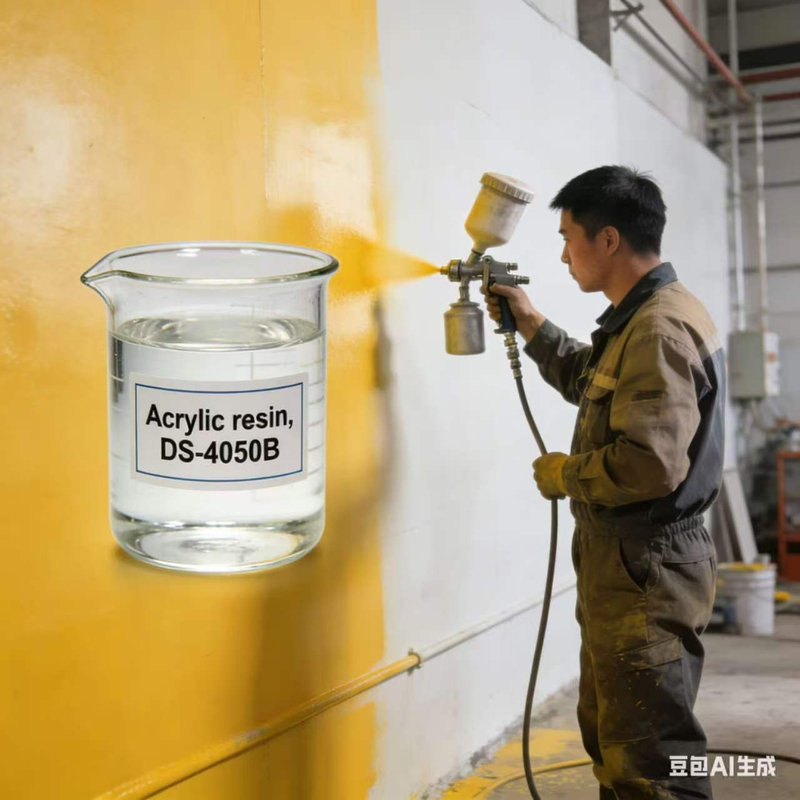


| Quantity: | |
|---|---|


DS-4050B
PYTHON
390690
Clear and Transparent
<1
Z2-Z4
50±2
3-7
TOL/BAC
Featuring low hydroxyl content, it exhibits excellent compatibility with CAB and NC. It is suitable for use as a primer or topcoat for plastics such as ABS, providing superior adhesion to subsequent paint layers. When blended with a small amount of chlorinated vinyl resin, it can also be utilized in nylon coatings.
The DS-4050B resin represents a sophisticated advancement in polymer engineering, specifically formulated as a copolymer derived from premium (meth)acrylate monomers. When integrated into intermediate coating systems, this clear and transparent liquid transforms into a robust, high-performance film that feels exceptionally smooth to the touch while maintaining structural integrity under severe environmental stress. Formulators will appreciate its pristine clarity and exceptionally low color index, which ensures that the final paint formulation remains untainted, visually striking, and completely free of unwanted amber or yellowish tints.
By incorporating a precisely controlled number of hydroxyl groups within its molecular architecture, this resin achieves a delicate balance of chemical reactivity and physical stability. The resulting paint film exhibits remarkable rapid drying characteristics, significantly accelerating production line throughput. Furthermore, its inherent structural properties grant it unparalleled weather resistance, shielding underlying substrates from ultraviolet degradation and harsh climatic variations. The fluid dynamics of this resin also allow for superior wetting and dispersion properties, ensuring that pigments—especially metallic flakes—are suspended uniformly, creating a flawless, radiant finish that meets the exacting standards of the modern automotive industry.
Parameter | Specification |
|---|---|
Appearance | Clear and Transparent |
Color | <1 |
Viscosity (Grifler tube, 25℃), seconds | Z2-Z4 |
Solids content (150℃, 1h), % | 50±2 |
Acid value (solution basis, mgKOH/g) | 3-7 |
Glass transition temperature (theoretical value), ℃ | 60 |
Solvent | TOL/BAC |
Developing high-tier automotive and motorcycle coatings requires foundation materials that do not compromise on performance. The DS-4050B acrylic resin is synthesized to address the most critical challenges faced by modern paint formulators, offering a synergistic blend of physical durability and chemical versatility.
Styrene-Free Architecture: Formulated without styrene to promote exceptional high weatherability, ensuring the coating resists yellowing, chalking, and degradation over extended periods of intense sun exposure.
Low Hydroxyl Functionality: The deliberate inclusion of a small number of hydroxyl groups enhances cross-linking potential without compromising the resin's inherent thermoplastic flexibility and flow properties.
Exceptional Substrate Versatility: Demonstrates aggressive adhesion profiles on both rigid metal surfaces and flexible ABS plastic components, creating a unified, reliable coating system across diverse vehicle parts.
Flawless Interlayer Adhesion: Acts as the perfect intermediate bridge, chemically and mechanically bonding with primer surfacers below and premium topcoats above to prevent long-term delamination.
Accelerated Curing Profile: The rapid-drying nature of the film minimizes dust-free time, allowing for faster handling, reduced contamination risks, and subsequent coating applications in high-volume environments.
To fully understand the transformative impact of the DS-4050B acrylic resin on your coating formulations, it is essential to examine its multi-dimensional performance metrics. Each aspect has been rigorously tested to ensure it meets the highest industrial standards.
Precision is paramount in large-scale paint production. This resin provides meticulously controlled parameters, including a consistent solids content of 50±2%, an acid value of 3-7 mgKOH/g, and a stable glass transition temperature of 60℃. These exact specifications guarantee batch-to-batch consistency, empowering coating engineers to maintain strict formulation tolerances and ensuring the ultimate reliability of the cured paint film.
Time is a critical resource in modern coating facilities. The inherently fast-drying characteristics of this thermoplastic acrylic significantly reduce waiting intervals between coats. By accelerating the flash-off and curing phases, it elevates the overall throughput of automotive and motorcycle painting lines, effectively lowering operational time costs while maximizing facility output.
A coating is only as strong as its weakest bond. DS-4050B exhibits aggressive, long-lasting adhesion to challenging substrates such as ABS plastics and raw metals. Furthermore, as an intermediate layer, it creates a tenacious mechanical and chemical interlock with topcoat layers, effectively mitigating the risk of peeling, flaking, or delamination under complex mechanical stresses and thermal cycling.
Achieving vibrant, uniform colors requires exceptional pigment handling. Thanks to its specialized molecular structure containing a precise fraction of hydroxyl groups, this resin boasts flawless compatibility with CAB (Cellulose Acetate Butyrate) and NC (Nitrocellulose). It wets out and disperses pigments with extraordinary efficiency—particularly metallic aluminum powders—ensuring optimal flake orientation, brilliant color development, and a luminous, mirror-like gloss.
Vehicles are subjected to relentless environmental assaults. Engineered specifically for outdoor transit applications, the resulting paint film delivers formidable weather resistance. It acts as a resilient shield against intense ultraviolet radiation, drastic temperature fluctuations, and corrosive atmospheric elements, ensuring that the vehicle's aesthetic appeal remains pristine and vibrant for years.
Transitioning from raw material to finished product should be seamless. Focused exclusively on the automotive and motorcycle intermediate coating sector, we provide comprehensive formulation support. By offering mature, production-ready reference formulas for metallic paints and detailed operational guides, we significantly lower the research and development threshold, drastically shortening the testing cycle for formulators.
Uninterrupted production demands uncompromising material integrity. We prioritize the highest purity of raw materials, evidenced by the resin's crystal-clear appearance and a color index of less than 1. Coupled with a highly stable TOL/BAC solvent system, our rigorous quality control protocols ensure that every drum delivered meets the stringent demands of continuous, large-scale industrial manufacturing.
To assist formulators in achieving optimal results, we provide a proven reference formula specifically designed for metallic paint applications. This guide ensures maximum utilization of the resin's wetting and dispersion capabilities, guaranteeing a premium finish.
Reference Formula for Metallic Paint:
DS-4050B: 50
Aluminum Powder: 6–8
CAB 381-0.5 (20%): 20
Additives (201P, BYK-104S, etc.): 1
Mixed Solvent: 20–25
Plasticizer: 1
Mixed Solvents: Approx. 14
Selecting the right supplier for critical chemical components is a strategic decision that impacts your entire production ecosystem. Our commitment extends far beyond merely delivering premium acrylic resins; we strive to be an integral part of your formulation success.
Uncompromising Quality Assurance: Every batch of our acrylic resin undergoes rigorous analytical testing to ensure it meets exact specifications for viscosity, solids content, and molecular weight distribution, eliminating guesswork from your production.
Formulation Expertise: Backed by a team of seasoned polymer chemists, we offer deep technical insights and troubleshooting support to help you perfect your automotive and motorcycle intermediate coatings.
Reliable Supply Continuity: As a dedicated manufacturer, we maintain robust inventory levels and streamlined logistics networks to ensure your production lines never experience downtime due to material shortages.
Innovative R&D Integration: We continuously refine our copolymerization techniques to stay ahead of industry trends, providing you with cutting-edge materials that meet evolving environmental and performance standards.
Below are some of the most common technical inquiries we receive from coating engineers and formulation specialists regarding the DS-4050B acrylic resin.
The compatibility is engineered at the molecular level. By incorporating a precisely calculated, small number of hydroxyl groups into the (meth)acrylate copolymer backbone, the resin achieves a polarity that perfectly aligns with Cellulose Acetate Butyrate (CAB) and Nitrocellulose (NC). This prevents phase separation and ensures a homogenous, clear film formation without hazing.
The Toluene (TOL) and Butyl Acetate (BAC) solvent blend offers an optimized evaporation rate. This specific combination ensures that the resin remains highly workable during application, allowing for excellent flow and leveling, while still flashing off rapidly enough to support the fast-drying characteristics required in high-efficiency painting facilities.
Yes, one of the standout properties of the DS-4050B resin is its exceptional direct adhesion to ABS plastic substrates. Its thermoplastic nature and specific molecular weight allow it to slightly bite into the ABS surface, creating a formidable mechanical bond that eliminates the absolute need for separate adhesion promoters in many standard automotive part applications.
A theoretical Tg of 60℃ strikes the perfect balance between hardness and flexibility. It ensures the intermediate coating is hard enough to be sanded easily if required, yet flexible enough to absorb mechanical impacts and thermal expansion without cracking, thereby protecting the integrity of both the underlying primer and the final topcoat.
The superior wetting and dispersion properties of this resin prevent the agglomeration of metallic flakes. By thoroughly coating each aluminum particle, the resin facilitates proper flake orientation parallel to the substrate. This uniform arrangement maximizes light reflectance, resulting in the brilliant, high-flop metallic finish desired in premium automotive paints.


