




| Quantity: | |
|---|---|


Clear and Transparent
<1
V-Y
50±2
2-5
TOL/MIBK/BAC
Low hydroxyl content with good alcohol solubility, excellent compatibility with CAB (cellulose acetate butyrate), NC, etc. Widely used as primers for ABS, PS, PC plastics (elastic primers), offering superior interlayer adhesion and broad versatility (can be ground into slurry, used as hydroxypropyl or baking paint resin).
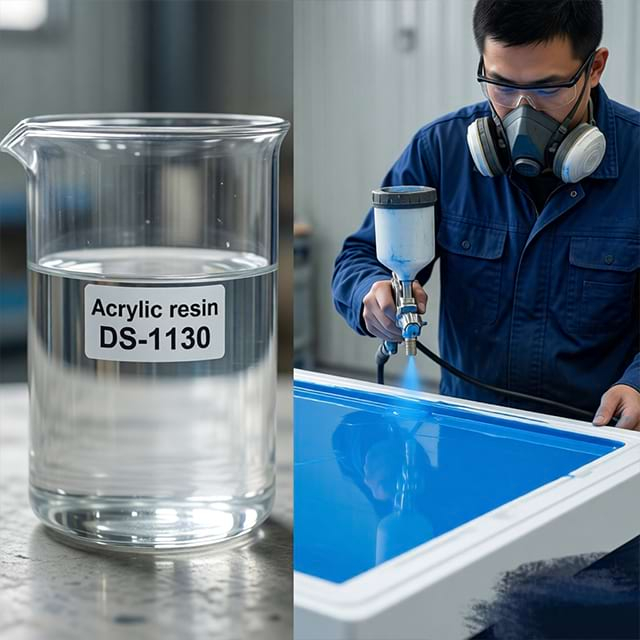
The Low-Hydroxyl Acrylic Resin DS-1130 is a meticulously synthesized copolymer of (meth)acrylate monomers and styrene, presenting itself as a pristine, water-white to slightly yellow liquid that is entirely free of mechanical impurities. When applied, the solution flows with a consistent, smooth viscosity, ensuring an even and flawless film formation essential for high-end finishing. The carefully balanced solvent matrix emits a characteristic chemical profile indicative of its rapid-drying and high-solubility nature. By significantly reducing the hydroxyl content, this resin minimizes moisture sensitivity during the curing phase, thereby preventing unwanted cloudiness and drastically enhancing the clarity and brilliance of the final finish. Formulators will appreciate the seamless blending experience; the liquid integrates effortlessly into complex matrices without clumping, hazing, or phase separation. Ultimately, this resin transforms ordinary, difficult-to-coat plastic surfaces into highly receptive substrates, locking subsequent topcoats in place with an unyielding mechanical and chemical grip that resists peeling, chipping, and environmental degradation over extended lifecycles.
Parameter | Specification |
|---|---|
Appearance | Clear and transparent, free of mechanical impurities. |
Color | Water-white to slightly yellow. |
Viscosity (Gestalt tube, 25℃), seconds | V-Y |
Solids content (150℃, 1h), % | 50±2 |
Acid value (solution basis, mgKOH/g) | 2-6 |
Glass transition temperature (theoretical value), ℃ | 50 |
Achieving a flawless finish on synthetic surfaces requires a foundation that bridges the gap between the substrate and the topcoat. This specialized resin is engineered precisely to act as that unbreakable bridge, offering a multitude of operational advantages for advanced paint manufacturing.
Unmatched Interlayer Adhesion: Creates a tenacious bond that securely anchors subsequent layers, including demanding PU varnishes, preventing long-term delamination.
Superior Alcohol Solubility: Dissolves cleanly and rapidly, streamlining the formulation process and reducing overall preparation time in the mixing vats.
Broad Versatility: Functions exceptionally well not only as a primary adhesion promoter but also as a hydroxypropyl and baking paint resin suitable for pigment grinding applications.
Crystal Clear Curing: Dries to a highly transparent state, ensuring that the true colors and metallic flakes in topcoats remain vivid and visually undistorted.
Consistency is the bedrock of large-scale manufacturing. Every batch of this acrylic copolymer is subjected to rigorous analytical testing to ensure it meets strict physicochemical benchmarks, guaranteeing predictable behavior in your mixing tanks and on the application line.
Reliable Solid Content: Maintained strictly at 50±2%, ensuring predictable coverage rates and consistent dry film thickness across massive production runs.
Optimized Viscosity Profile: The V-Y second rating (Gestalt tube, 25℃) guarantees excellent flow and leveling properties, which are crucial for automated spray applications.
Controlled Acid Value: Kept safely between 2-6 mgKOH/g to prevent unwanted chemical reactions with sensitive pigments or metallic flakes, such as aluminum powder.
Ideal Glass Transition (Tg): Engineered with a theoretical Tg of 50℃, striking the perfect balance between surface hardness and the necessary flexibility to withstand substrate thermal expansion.
Modern manufacturing utilizes a vast array of synthetic polymers, each presenting unique surface tension challenges. This specialized formulation is designed to wet out and adhere to some of the most notoriously difficult plastics used in consumer electronics, automotive interiors, and household appliances.
Broad Plastic Compatibility: Exhibits aggressive bite into ABS, PS, PC, and HIPS, forming an inseparable mechanical and chemical bond that outlasts standard primers.
Single-Component Glitter Paints: Acts as the perfect suspension medium for metallic flakes, keeping them evenly distributed for a brilliant, sparkling finish.
Solid Color Coatings: Provides a smooth, uniform base that significantly enhances the opacity and visual depth of single-component solid color paints.
Automotive Intermediate Coats: Delivers the necessary build and sandability required for high-end automotive refinishing and original equipment manufacturing (OEM) applications.
Elastic Primer Applications: Maintains sufficient flexibility to move with the plastic substrate, preventing microscopic cracking under physical stress or impact.
Efficiency in the formulation lab directly translates to profitability on the production floor. This resin has been synthesized to eliminate common bottlenecks in paint manufacturing, offering an incredibly user-friendly experience for chemical engineers and line operators alike.
Exceptional CAB & NC Compatibility: Blends seamlessly with Cellulose Acetate Butyrate and Nitrocellulose without kicking out or hazing, allowing for complex, high-performance formulations.
Low-Hydroxyl Formulation: The reduced hydroxyl content minimizes the risk of moisture-induced defects, ensuring a stable shelf life and consistent application even in highly humid environments.
Excellent Recoatability: Readily accepts a wide variety of topcoats, including demanding Polyurethane (PU) clear coats, without wrinkling, lifting, or compromising the base layer.
Smooth Grinding Characteristics: Highly suitable for pigment dispersion, wetting out dry pigments rapidly to achieve maximum color strength in significantly less milling time.
To accelerate your research and development phase, our technical engineering team provides proven starting point formulations. This reduces trial-and-error, allowing you to bring high-quality coatings to market faster. Below is a highly effective reference formulation for a premium single-component glitter paint.
DS-1130 Base Resin: 50 parts — Forms the durable, highly adhesive backbone of the coating system.
Glitter Silver Powder: 8-10 parts — Provides the desired metallic brilliance and visual depth.
CAB 381-0.5 (20% solution): 10-20 parts — Enhances metallic flake orientation and accelerates the physical drying process.
Specialized Additives (e.g., 201P): 1 part — Ensures optimal flow, leveling, and anti-settling properties in the container.
Mixed Solvent System: 20-30 parts — Adjusts the final viscosity for flawless, atomized spray application.
Navigating the complexities of global chemical compliance requires a partner dedicated to absolute transparency and rigorous standards. We ensure that every drum leaving our facility meets the highest international benchmarks for quality, safety, and environmental responsibility.
ISO Certified Manufacturing: Produced in state-of-the-art facilities governed by strict ISO quality management systems, ensuring virtually zero batch-to-batch variation.
CE Compliance: Meets the stringent health, safety, and environmental protection standards required for distribution and application within global markets.
Comprehensive COA: Every shipment is accompanied by a detailed Certificate of Analysis, providing exact empirical data for your internal quality assurance protocols.
Detailed MSDS Documentation: Fully compliant Material Safety Data Sheets are provided to ensure safe handling, proper storage, and rapid emergency response procedures.
Chemical integrity must be preserved from our reactors all the way to your mixing vats. We utilize industrial-grade packaging and optimized logistics networks to ensure your materials arrive safely, on time, and in pristine condition.
Robust Industrial Packaging: Securely sealed in heavy-duty containers designed to prevent contamination, minimize solvent evaporation, and withstand rigorous transit conditions.
Optimized Storage Conditions: Formulated to remain highly stable when stored in cool, dry, and well-ventilated environments, safely away from direct sunlight and ignition sources.
Extended Shelf Life: When kept in unopened, original containers under recommended conditions, the resin maintains its reactive properties and viscosity for extended periods.
Rapid Global Dispatch: Leveraging optimized supply chains to guarantee a swift delivery window of just 7 to 15 days, strictly depending on order volume and final destination.
Securing a reliable source for critical raw materials is paramount for uninterrupted production. As a deeply integrated manufacturer and supplier, we offer unparalleled supply chain resilience and flexible commercial terms designed to support large-scale operations worldwide.
Integrated Production & Trade: By combining direct manufacturing capabilities with extensive global trade networks, we eliminate unnecessary delays and reduce overall lead times.
Scalable Capacity: Our robust infrastructure is designed to fulfill both routine continuous orders and sudden surges in demand without ever compromising on chemical quality.
Flexible Financial Terms: We accommodate diverse corporate procurement policies by accepting multiple negotiable payment methods, including TT, LC, PayPal, and major credit cards.
Dedicated Export Division: A specialized team focused entirely on international logistics, customs clearance, and client communication ensures a completely frictionless procurement experience.
Selecting the right chemical partner is a strategic decision that impacts every facet of your product's success. We go beyond merely supplying raw materials; we provide comprehensive solutions that elevate your manufacturing capabilities and end-product quality.
Uncompromising Purity: Our advanced filtration and synthesis techniques guarantee a resin free from mechanical impurities, safeguarding your delicate application equipment from clogs and wear.
Technical Expertise: Decades of experience in polymer chemistry allow us to offer deep technical insights and rapid troubleshooting support for your specific, proprietary formulations.
Consistent Market Supply: We maintain strategic reserves of critical raw materials, shielding our partners from sudden market shortages, supply chain shocks, and price volatilities.
Commitment to Innovation: Continuous investment in research and development ensures our product lines evolve to meet the ever-changing performance demands of the modern coatings industry.
To further assist your procurement and engineering teams, we have compiled detailed answers to the most common technical and commercial inquiries regarding our acrylic copolymer solutions.
Q1: How does the low hydroxyl content specifically benefit the final coating formulation?
A: A low hydroxyl value significantly reduces the resin's affinity for ambient moisture. This prevents critical issues like blushing or cloudiness during the drying phase, especially in high-humidity environments, ensuring a consistently clear, glossy, and defect-free finish.
Q2: Can this resin be used directly over untreated PP (Polypropylene) or PE (Polyethylene) plastics?
A: While DS-1130 exhibits exceptional, aggressive adhesion to ABS, PS, PC, and HIPS, polyolefins like PP and PE have extremely low surface energy. For those specific substrates, a dedicated adhesion promoter or surface treatment (such as flame or corona treatment) is required prior to applying this primer.
Q3: What makes this resin particularly suitable for single-component glitter and metallic paints?
A: Its excellent compatibility with CAB (Cellulose Acetate Butyrate) is the key factor. CAB assists in the rapid setting of the paint film, which effectively freezes the metallic flakes (like silver powder) in an optimal parallel orientation, maximizing the visual "flop" effect and overall metallic brilliance.
Q4: Are there any specific solvent restrictions or recommendations when formulating with DS-1130?
A: The resin is supplied in a precise blend of toluene, MIBK, and butyl acetate and boasts excellent alcohol solubility. However, when formulating, it is crucial to maintain a balanced solvent system to prevent shocking the resin or causing phase separation when blending with other binders like Nitrocellulose.
Q5: How do you ensure batch-to-batch consistency for continuous, large-scale orders?
A: We employ rigorous ISO-certified quality control protocols at every stage of production. Every single batch undergoes strict laboratory testing for viscosity (V-Y seconds), solid content (50±2%), and acid value (2-6 mgKOH/g) before a comprehensive Certificate of Analysis (COA) is issued and the batch is approved for dispatch.


