


Views: 0 Author: Site Editor Publish Time: 2026-10-23 Origin: Site


Every formulation engineer knows the struggle. You mix a two-component coating. It either shatters under impact or turns mushy in harsh chemical environments. The culprit is rarely the solvent. It is almost always the molecular structure. In high-performance polyurethane systems, the hydroxy acrylic resin acts as the foundational base. Chemists juggle countless variables from solvent selection to rheology modifiers. Yet, one metric consistently dictates success. That metric is the hydroxyl value. This parameter controls crosslinking density. Consequently, it governs the durability and aesthetic lifespan of the final paint film. In this comprehensive guide, you will learn how to optimize your formulations by mastering this essential chemical metric.
A hydroxy acrylic resin is widely known in the chemical manufacturing sector as an acrylic polyol. It is a specialized synthetic polymer engineered for heavy-duty protective and decorative finishes. The core structure features an acrylic polymer backbone. This backbone is synthesized from various acrylate and methacrylate monomers. During polymerization, manufacturers deliberately incorporate functional monomers like hydroxyethyl methacrylate. This strategic synthesis introduces active hydroxyl groups along the polymer chain. These groups create the reactive sites necessary for crosslinking.
In a practical setting, this resin serves as the primary binder. Transitioning from a liquid state to a cured solid film requires a chemical reaction with a hardener. This hardener is typically an aliphatic or aromatic polyisocyanate. When a technician mixes these two parts in a commercial spray booth, a rapid chemical handshake occurs. The hydroxyl groups on the acrylic resin react with the isocyanate groups on the hardener. This forms highly stable urethane linkages. The result is a dense three-dimensional crosslinked network. It cures efficiently at ambient room temperature or under low-heat baking conditions.
Industry professionals strongly prefer these materials over alternative polyols like polyesters or alkyds for top-tier applications. The main advantages include exceptional outdoor weatherability and superior ultraviolet light resistance. Furthermore, they offer robust color stability over extended periods. The acrylic backbone naturally resists hydrolysis and photo-oxidation. Therefore, the resulting finishes maintain their brilliant gloss and structural integrity even after years of harsh environmental exposure.
Formulators rely on precise quantitative metrics rather than guesswork when evaluating raw materials. The hydroxyl value is universally regarded as the primary specification a paint chemist examines. By definition, it measures the content of free hydroxyl groups present in a chemical substance. Laboratory technicians typically determine this through a rigorous acetylation method. The result is expressed as the mass of potassium hydroxide in milligrams chemically equivalent to the hydroxyl content of one gram of the solid resin.
It is vital to distinguish between the hydroxyl value and the hydroxyl content percentage. Both metrics frequently appear side-by-side on technical data sheets. The hydroxyl content represents the mass percentage of active groups relative to the total mass of the resin. Chemists frequently convert between these two figures to perform accurate stoichiometric calculations on the production floor. The empirical conversion formula is straightforward. The hydroxyl value equals the hydroxyl content percentage multiplied by thirty-three.
Looking at broader industry shifts, stringent environmental regulations are fundamentally changing formulation strategies. The global coatings sector is aggressively transitioning toward high-solids and low volatile organic compound formulations. Formulators are losing the luxury of using heavy solvents to adjust viscosity and flow. This regulatory pressure amplifies the importance of precise hydroxyl value calculations. Modern high-solids resins must possess an impeccably dialed-in molecular weight and hydroxyl value. A highly accurate metric ensures the crosslinking network cures rapidly and achieves optimal mechanical properties without relying on traditional solvent evaporation.
The fundamental principle governing two-component polyurethane performance is crosslinking density. The hydroxyl value directly dictates how many reaction sites are available on the polymer chain. A higher number means more reaction points for the isocyanate. This results in a tightly knit molecular network. Conversely, a lower value creates fewer connections and a looser network. This microscopic density governs nearly every physical and chemical characteristic of the finish.
Empirical data demonstrates a direct correlation between this metric and the mechanical hardness of the cured film. Resins heavily loaded with hydroxyl groups produce a highly restrictive dense crosslinked network. This limited molecular mobility translates to a higher glass transition temperature and superior surface hardness. In practical applications, coatings formulated with these materials achieve premium ratings on the pencil hardness scale. They exhibit exceptional resistance to micro-scratching. This makes them ideal for heavy machinery or automotive clearcoats subjected to daily mechanical abrasion.
Polymer chemistry dictates an inherent inverse relationship between hardness and flexibility. Lower hydroxyl values yield a looser and more relaxed molecular network. The physical distance between crosslink nodes is greater. Therefore, the polymer chains retain significant elasticity. This allows the cured paint film to stretch, bend, and absorb kinetic energy without fracturing. For substrates that undergo thermal expansion or physical bending, a lower metric is strictly required to prevent catastrophic delamination upon impact. Examples include automotive plastic bumpers or flexible metal sheets.
A dense crosslinked network acts as an impenetrable microscopic fortress. When the urethane linkages are tightly packed, aggressive solvent molecules, industrial acids, and moisture struggle to penetrate the film. Specifically, high-density formulations offer superior chemical inertness. This tight structure also provides enhanced physical protection against photo-oxidation caused by ultraviolet radiation. This leads to vastly improved long-term weatherability in outdoor environments.
The concentration of active hydroxyl groups significantly influences the reaction kinetics on the shop floor. A higher concentration increases the statistical probability of molecular collisions with isocyanate groups. This drastically accelerates the chemical reaction. Fast-tracking drying times allows for quicker return-to-service. However, it simultaneously reduces the pot life. Pot life is the critical window of time the applicator has to spray the paint after mixing the two parts. Formulators must carefully balance this desire for rapid curing with a practical user-friendly application window.
Performance Metric | Low Hydroxyl Value Under 60 mg KOH/g | High Hydroxyl Value Over 100 mg KOH/g |
|---|---|---|
Crosslinking Density | Low | High |
Film Hardness | Moderate to Low | Very High |
Flexibility and Bending | Excellent | Poor and Brittle |
Chemical Resistance | Moderate | Exceptional |
Curing Speed | Slower | Faster |
Pot Life | Longer | Shorter |
Selecting the correct raw material requires aligning the chemical properties with the specific mechanical and environmental demands of the target substrate. Formulators generally categorize these polymers into three primary ranges to simplify the selection process.
Engineered for maximum durability and chemical inertness, these resins are the industry standard for premium automotive clearcoats, heavy-duty industrial machinery coatings, and anti-corrosion marine topcoats. The intense crosslinking density ensures the coating easily withstands harsh chemical spills, constant ultraviolet exposure, and severe mechanical wear. The resulting finish provides a brilliant high-gloss appearance. It maintains its aesthetic integrity over years of demanding service.
These variants are utilized when elasticity and substrate adhesion must take precedence over extreme surface hardness. Typical applications include coatings for consumer electronics, automotive interior plastics, leather finishes, and specialized wood coatings. These substrates are inherently flexible or highly porous. A rigid coating would quickly crack and peel away. An added economic advantage is that these formulations require significantly less expensive isocyanate hardener to achieve full curing. This noticeably reduces the overall raw material cost per gallon.
For a vast majority of industrial applications, neither extreme hardness nor extreme flexibility is strictly required. Resins with a medium hydroxyl value offer a highly practical compromise. These are frequently selected for general metal finishes, commercial vehicle fleet coatings, and agricultural equipment. They provide sufficient scratch resistance to survive daily operational use. At the same time, they maintain just enough flexibility to resist chipping from minor physical impacts or sudden temperature fluctuations.
Formulating a high-performance 2K polyurethane coating requires far more precision than simply mixing a base and a hardener in a bucket. The chemistry of curing relies on a mathematically precise stoichiometric balance. The fundamental reaction in these systems occurs when the isocyanate groups meet the hydroxyl groups provided by the acrylic polyol.
To achieve an optimal reaction, chemists target a specific index. This index typically ranges from 1.05 to 1.10. This means the isocyanate is slightly in excess. The excess accounts for inevitable reactions with ambient moisture in the air or solvents. Moisture would otherwise steal isocyanate molecules away from the primary crosslinking reaction. The calculation relies heavily on the exact hydroxyl value provided on the manufacturer technical data sheet.
Deviating from this calculated ratio leads directly to severe and costly coating failures. In an under-crosslinking scenario, unreacted hydroxyl groups are left stranded in the polymer network. The resulting film remains soft, tacky, and highly susceptible to solvent attack and moisture penetration. This leads to premature failure and warranty claims. In contrast, over-crosslinking forces excess isocyanate to react heavily with ambient moisture. This forms urea linkages and releases carbon dioxide gas. The coating becomes overly brittle and prone to micro-cracking. It often plagues the surface with pinhole defects from trapped gas. Furthermore, it wastes valuable capital by over-consuming the most expensive component in the formulation.
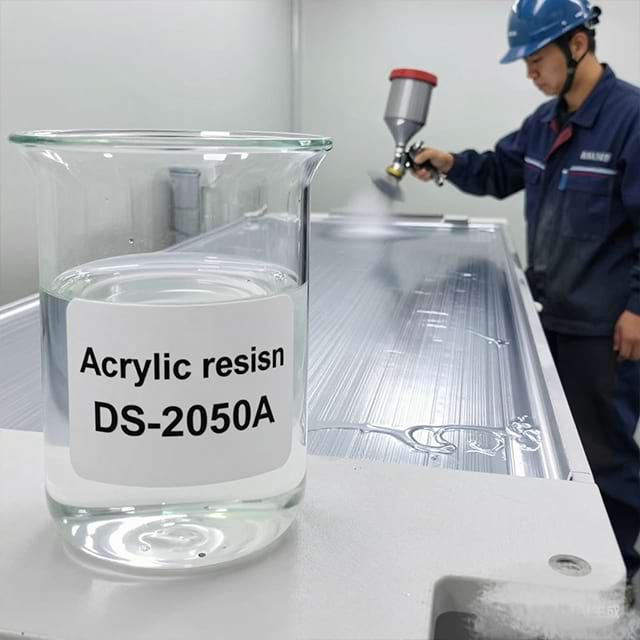
For procurement managers and lead chemists, selecting the foundational resin requires evaluating empirical data, batch consistency, and application versatility. The market demands materials that deliver measurable results without complicating the manufacturing process. This is precisely why highly engineered solutions like Hydroxy-Polyol Acrylic Resin DS-2050A have become a staple for demanding industrial and automotive applications.
The structural design of a polymer dictates its practical utility on the production line. This specific resin is synthesized to maintain an optimized hydroxyl value that hits the sweet spot in coating chemistry. It provides enough reaction sites to ensure a dense protective urethane network. Yet, it maintains sufficient spacing between polymer chains to prevent severe embrittlement. This balanced profile allows formulators to achieve excellent surface leveling and high gloss. It minimizes surface tension issues while building a robust mechanical profile. Standard specifications for such premium grades often feature a solid content around 70 percent and a precisely controlled hydroxyl value optimized for medium-to-high solid systems.
In rigorous laboratory testing and field applications, this premium material exhibits several distinct advantages. The primary benefit is its rapid physical drying time. By optimizing the molecular weight alongside the hydroxyl value, the resin facilitates efficient solvent release and faster crosslinking. This significantly improves throughput in commercial spray booths. Additionally, the polymer architecture is highly resistant to ultraviolet degradation. This ensures outstanding long-term weatherability. For clearcoat formulations, this structural clarity results in a brilliant distinctness of image. It provides the mirror-like finish expected in luxury sectors.
Due to its balanced chemical profile and robust resistance properties, it is highly recommended for environments demanding both aesthetic perfection and structural durability. It serves as an ideal primary binder for automotive refinishing paints, premium industrial metal coatings, and high-durability protective topcoats for commercial transport vehicles. Chemical engineers frequently reference these specific parameters to seamlessly integrate the material into their current product lines.
Identifying a high-quality material in a controlled laboratory setting is only the first step. Moving beyond the laboratory and into industrial-scale paint manufacturing brings new challenges. The reliability of the supply chain and the consistency of the raw materials become equally critical to operational success and profit margins.
In polyurethane formulations, consistency matters immensely. The hydroxyl value is not a flexible parameter. If a supplier delivers a batch where the value fluctuates by even a few milligrams, the previously established stoichiometric ratio becomes entirely invalid. This inconsistency forces chemists to constantly recalibrate their hardener formulations for every new batch. It wastes valuable production time and increases the risk of human error. Integrating a reliable premium acrylic polyol from a manufacturer that enforces strict narrow specifications ensures batch-to-batch uniformity. This safeguards your manufacturing efficiency.
Compatibility is another vital procurement metric. Formulators must verify that the chosen resin exhibits broad compatibility with standard aliphatic isocyanates like biurets or trimers. The resin must remain stable and soluble in common industrial solvents including esters and ketones. It should not precipitate or cause unwanted viscosity spikes when various flow additives or rheology modifiers are introduced.
Finally, technical support should never be overlooked. Procuring chemical raw materials should function as a partnership rather than a simple transaction. Reliable suppliers provide comprehensive documentation including detailed technical data sheets and accurate safety data sheets. Access to transparent formulation guidance ensures that chemical engineers can optimize their systems efficiently. This reduces research and development time and brings superior coatings to market much faster.
Thermoplastic resins cure entirely through solvent evaporation. Their polymer chains entangle but do not chemically bond. This means they can be easily re-melted or dissolved by aggressive solvents later on. Thermosetting resins contain active functional groups. These groups chemically react with a hardener to form a permanent crosslinked polyurethane network. This network will not melt or dissolve once fully cured, offering vastly superior chemical resistance.
The value is typically quantified in a laboratory setting using a standard titration method. The resin sample is acetylated using a reagent like acetic anhydride. The excess acid remaining after the reaction is then titrated with a standardized potassium hydroxide solution. The final result is expressed as the milligrams of potassium hydroxide equivalent to the hydroxyl content of exactly one gram of the solid resin.
Yes. An optimized hydroxyl value combined with a stable acrylic backbone provides excellent ultraviolet resistance and mechanical durability. This makes it highly suitable for formulating automotive clearcoats and solid color topcoats. It ensures a high-gloss finish that resists weathering, scratching, and chemical exposure from harsh automotive fluids like brake fluid or gasoline.
An incorrect stoichiometric ratio fundamentally compromises the integrity of the paint film. If you use too little hardener, the paint remains soft, tacky, and highly vulnerable to chemical degradation. Conversely, using too much hardener results in a highly brittle coating. It becomes prone to shrinking, micro-cracking, and peeling away from the substrate due to trapped gases from moisture reactions.
Generally, yes. A resin with a higher value contains more active reaction sites. To achieve full crosslinking, it mathematically requires a proportionally larger volume of isocyanate hardener. Because high-quality aliphatic isocyanates are typically the most expensive components within a polyurethane system, increasing the hardener demand naturally increases the overall raw material cost per gallon of the mixed paint.
A higher value provides more reactive sites for the isocyanate hardener. This increased density of reactive points accelerates the chemical crosslinking process. Consequently, the coating achieves a tack-free state and physical hardness much faster. However, this rapid curing also significantly shortens the workable pot life.
Automotive clear coats require an exceptional balance of scratch resistance, high gloss, and chemical durability. Formulators typically select resins with a value ranging from 80 to 120 milligrams of potassium hydroxide per gram. This specific range guarantees the dense crosslinking necessary to withstand car washes, ultraviolet radiation, and environmental fallout without becoming overly brittle.
The hydroxyl value is the undisputed steering wheel of your coating performance. It dictates whether the final finish will be rock-hard and chemically inert or flexibly resilient enough to absorb physical impacts. Choosing the right base material is critical to navigating the delicate balance between these performance metrics.
Formulators must rely on accurate technical specifications and consistent raw materials to avoid costly production failures. By understanding the profound impact of crosslinking density and mastering the stoichiometric ratio, chemical engineers can design coatings that consistently outperform the competition in both durability and aesthetics.
Upgrade your paint formulations with reliable and meticulously engineered materials today. Review the technical data of Hydroxy-Polyol Acrylic Resin DS-2050A for better and more predictable results on the production floor. Reach out to the dedicated technical team at TantoHK for material samples and expert formulation advice. Elevate your next industrial or automotive coating project by choosing the perfect resin for your specific application needs.


